









Quick answer: “Error establishing a database connection” means WordPress can’t reach the database that stores your content — usually caused by wrong credentials in wp-config.php, a database server that’s down or overloaded, or a corrupted database. A 500 Internal Server Error is a different, more general error — it’s sometimes caused by a database problem, but far more often it’s a PHP memory limit, a plugin conflict, or a broken .htaccess file. This post covers both, and how to tell which one you’re actually dealing with.
Table of contents
What “error establishing a database connection” actually means
Nearly everything that makes up your site — the posts themselves, page settings, user logins, most plugin configuration — lives inside a MySQL or MariaDB database rather than in the files you’d see through an FTP client. Loading any page means WordPress first has to open a connection to that database and pull what it needs before it can render anything at all. This error shows up specifically when that opening handshake never succeeds — not a slow response, not a partial read, but a connection that never gets made in the first place.
What causes it
- Incorrect database credentials. The database name, username, password, or host in wp-config.php doesn’t match what the database server actually expects — often after a migration, a manual server change, or a hosting switch.
- The database server is down or unresponsive. This can be a hosting-side outage, a server restart, or the database process crashing under load.
- Too many simultaneous connections. Shared hosting environments cap how many database connections can be open at once. A traffic spike or an inefficient plugin running excessive queries can hit that ceiling, and every new visitor gets this error until connections free up.
- A corrupted database. Database tables can become corrupted from an interrupted import, an abrupt server crash, or a failed update — WordPress can technically reach the database but can’t read the damaged tables correctly.
- A corrupted wp-config.php file itself, less commonly — if the file has been partially overwritten or has a syntax error, WordPress may fail before it even gets to the credentials.
Step-by-step: how to fix it
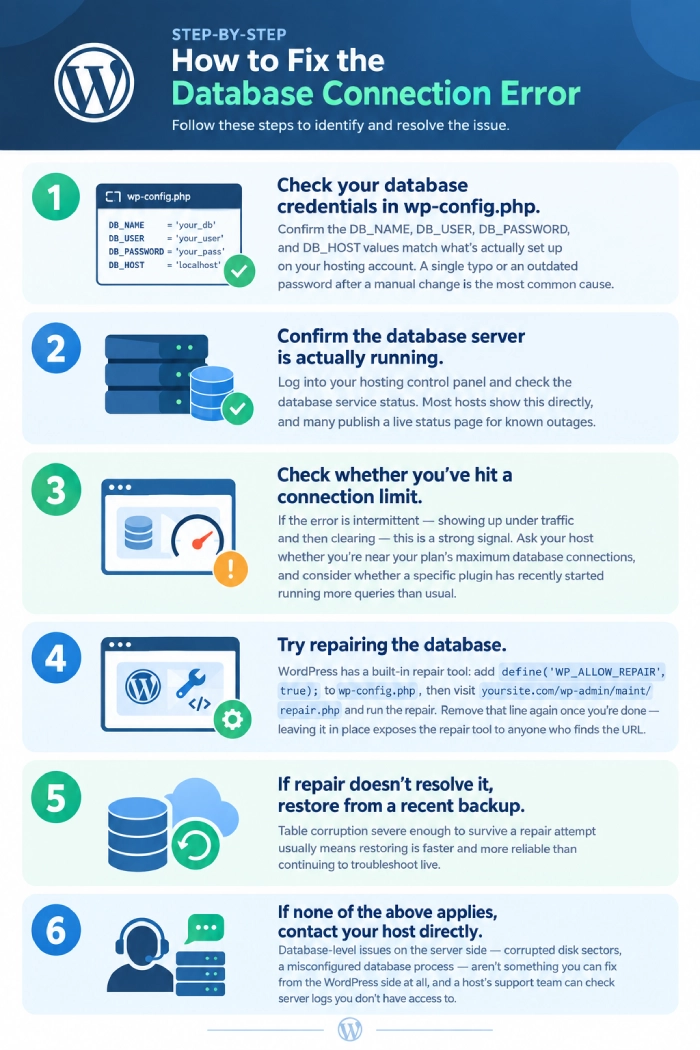
- Check your database credentials in wp-config.php. Confirm the DB_NAME, DB_USER, DB_PASSWORD, and DB_HOST values match what’s actually set up on your hosting account. A single typo or an outdated password after a manual change is the most common cause.
- Confirm the database server is actually running. Log into your hosting control panel and check the database service status. Most hosts show this directly, and many publish a live status page for known outages.
- Check whether you’ve hit a connection limit. If the error is intermittent — showing up under traffic and then clearing — this is a strong signal. Ask your host whether you’re near your plan’s maximum database connections, and consider whether a specific plugin has recently started running more queries than usual.
- Try repairing the database. WordPress has a built-in repair tool: add define(‘WP_ALLOW_REPAIR’, true); to wp-config.php, then visit com/wp-admin/maint/repair.php and run the repair. Remove that line again once you’re done — leaving it in place exposes the repair tool to anyone who finds the URL.
- If repair doesn’t resolve it, restore from a recent backup. Table corruption severe enough to survive a repair attempt usually means restoring is faster and more reliable than continuing to troubleshoot live.
- If none of the above applies, contact your host directly. Database-level issues on the server side — corrupted disk sectors, a misconfigured database process — aren’t something you can fix from the WordPress side at all, and a host’s support team can check server logs you don’t have access to.
Is a 500 Internal Server Error actually a database problem?
Sometimes — but usually not. A 500 error is WordPress and your server’s generic way of saying “something went wrong” without specifying what. It gets triggered by a much wider range of causes than a database connection failure does.
When a 500 error is database-related: – The database is so overloaded that queries are timing out rather than failing outright, which can surface as a 500 instead of the specific database connection message – A corrupted table is causing a PHP fatal error partway through a page load, rather than failing cleanly at the connection stage
When it’s not database-related (the more common case): – A PHP memory limit being exceeded – A corrupted .htaccess file – A plugin or theme conflict, especially right after an update – A PHP syntax error in a theme’s functions.php or a custom code snippet – A server-level timeout on a long-running process
How to tell the difference: check your error log. Your host’s error log or WordPress’s own debug.log (enabled by adding define(‘WP_DEBUG_LOG’, true); to wp-config.php) will usually name the actual cause. If the log mentions wpdb, MySQL, or a connection timeout, you’re looking at a database issue and the steps above apply. If it names a specific plugin file, a memory exhaustion message, or a PHP syntax error, the fix is elsewhere — typically deactivating the plugin in question or raising the PHP memory limit.
Preventing both going forward
- Keep the database optimized. Bloated tables (old post revisions, spam comments, orphaned data from uninstalled plugins) make every query slower and more likely to time out under load.
- Match your hosting plan to your actual traffic. A site that’s outgrown shared hosting’s connection limits will keep hitting this error under normal traffic, not just during spikes.
- Test updates on staging before they touch production. Most 500 errors that aren’t database-related trace back to an update that wasn’t tested first.
- Keep a recently tested backup on hand. Whether the cause turns out to be database corruption or something else entirely, a good backup turns a stressful diagnosis into a fast recovery.
Should you fix this yourself, or call in a professional?
Every fix above is something a site owner can attempt to do — credentials, connection limits, and even the repair tool are all reachable from a standard hosting control panel. But there’s a real gap between “possible to do yourself” and “the fastest, safest way to actually get it done,” and a few things tend to tip the balance toward bringing in a WordPress professional or agency rather than troubleshooting solo:
- The risk of making it worse. Editing wp-config.php, running a database repair, or restoring a backup can all cause real data loss if done incorrectly — and unlike deactivating a plugin, a mishandled database fix isn’t always something you can simply undo. Someone who’s done this hundreds of times knows which steps are safe to attempt live and which absolutely need a backup in hand first.
- Diagnosis speed. Correctly reading a raw error log and identifying whether you’re looking at a credentials problem, a connection limit, or table corruption takes pattern recognition that mostly comes from repetition. What takes a site owner an anxious hour of searching often takes an experienced developer a few minutes, because they’ve already seen the exact error many times before.
- Access to tools most site owners don’t have. Checking actual database connection counts, reading MySQL logs directly, or spotting a resource cap your host hasn’t flagged usually requires a level of server access and technical fluency beyond what a standard hosting dashboard offers.
- The cost of your own time. Every hour spent troubleshooting a down site is an hour not spent running the business behind it — for a revenue-generating site, that hour typically costs more than professional help would have.
- It rarely happens in isolation. A site that hits this error once often has an underlying condition behind it — undersized hosting, a poorly optimized plugin, an outdated PHP version — that keeps causing problems until someone actually addresses the root cause instead of just clearing the immediate error.
Working through the fixes above yourself is a reasonable first move, and understanding what’s happening is useful regardless of who ends up fixing it. But if the site is business-critical, or the steps above don’t resolve it, it’s usually faster and safer to bring in a web agency or WordPress specialist than to keep troubleshooting alone — fixing a one-off error yourself is a very different thing from having someone catch the underlying cause before it happens again.
FAQs
Not necessarily. In most cases the database is intact and simply unreachable or temporarily overloaded — fixing the connection or the credentials restores everything. Data loss is a real risk only with severe corruption, which is why testing backups matters.
Indirectly, yes — a poorly optimized plugin running excessive queries can push a site past its connection limit, especially on shared hosting. It’s a different mechanism than a plugin causing a 500 error, but the practical fix (deactivate and test) is similar.
That pattern usually points to a connection limit being hit under load rather than a hard credentials or corruption problem — if it were credentials, the error would be constant.
If it’s a straightforward credentials mismatch, that’s safe to fix yourself. If you’re looking at database repair or corruption, and especially if you don’t have a recently tested backup, it’s worth bringing in someone experienced rather than risking further damage while troubleshooting live.
Need a strong team specialised in WordPress Website Maintenance?
Speak to SBWD today to get a free website security audit to see what security gaps there are to fill.