







Quick answer: An AI website builder is enough if you need a simple site, fast, mainly to look credible online. Choose a web design company Singapore if your website must bring in enquiries, rank on Google, or connect to your business systems such as bookings, payments or a CRM. Most Singapore SMEs fall somewhere in between. The useful question is not "AI or human", but how much your business depends on the website working hard for you.
Table of contents
AI builder vs web designer at a glance
| AI website builder | Web designer or agency | |
|---|---|---|
| Upfront Cost | Low: a monthly subscription | S$4,000 – $8,000 for a typical SME site |
| Time to launch | 10-15 days | 6–12 weeks |
| Design | Generated from templates; often looks like other sites | Built around your brand and customers |
| Copywriting | Generic AI text you must rewrite | Written for your audience and search terms |
| SEO | Basic settings; structure is up to you | Planned page structure, keywords, technical setup |
| Integrations | Limited to the platform's apps | Booking, CRM, PayNow, ERP as needed |
| Ownership | Site lives on the platform; hard to move | You own the domain, hosting and files |
| Support | Help articles and chat | A team that knows your site |
When an AI website builder is enough
AI builders are genuinely useful. They are a sensible choice when:
- You’re testing a new business idea and need a page up this week.
- Most customers come through referrals, and the site only confirms you exist.
- It’s a one-off page, such as an event, a launch or a portfolio.
- Your budget is under S$2,000 and you have time to write and update the content yourself.
If that describes you, start with an AI builder and invest later, once the business needs more from its website.
Where AI builders fall short for SMEs
The problems usually appear after launch, when the site is expected to bring in business.
It sounds like everyone else. AI-generated copy is built from what already exists online. A Singapore renovation firm, clinic or law practice ends up with text that could describe any competitor, which gives customers no reason to choose you.
It isn’t built to be found. AI builders produce pages, not a search strategy. Which pages exist, what each one targets, and how they link together still need human planning.
It can’t do what your business needs. Online booking tied to your clinic system, quotation forms that feed your CRM, PayNow checkout, or English and Chinese versions often hit the platform’s limits.
You don’t fully own it. Most AI-built sites live on the builder’s platform. Moving later usually means rebuilding from scratch.
Compliance is on you. PDPA-compliant consent, privacy notices and accessibility are rarely handled properly by default.
Example: the form that never sent.
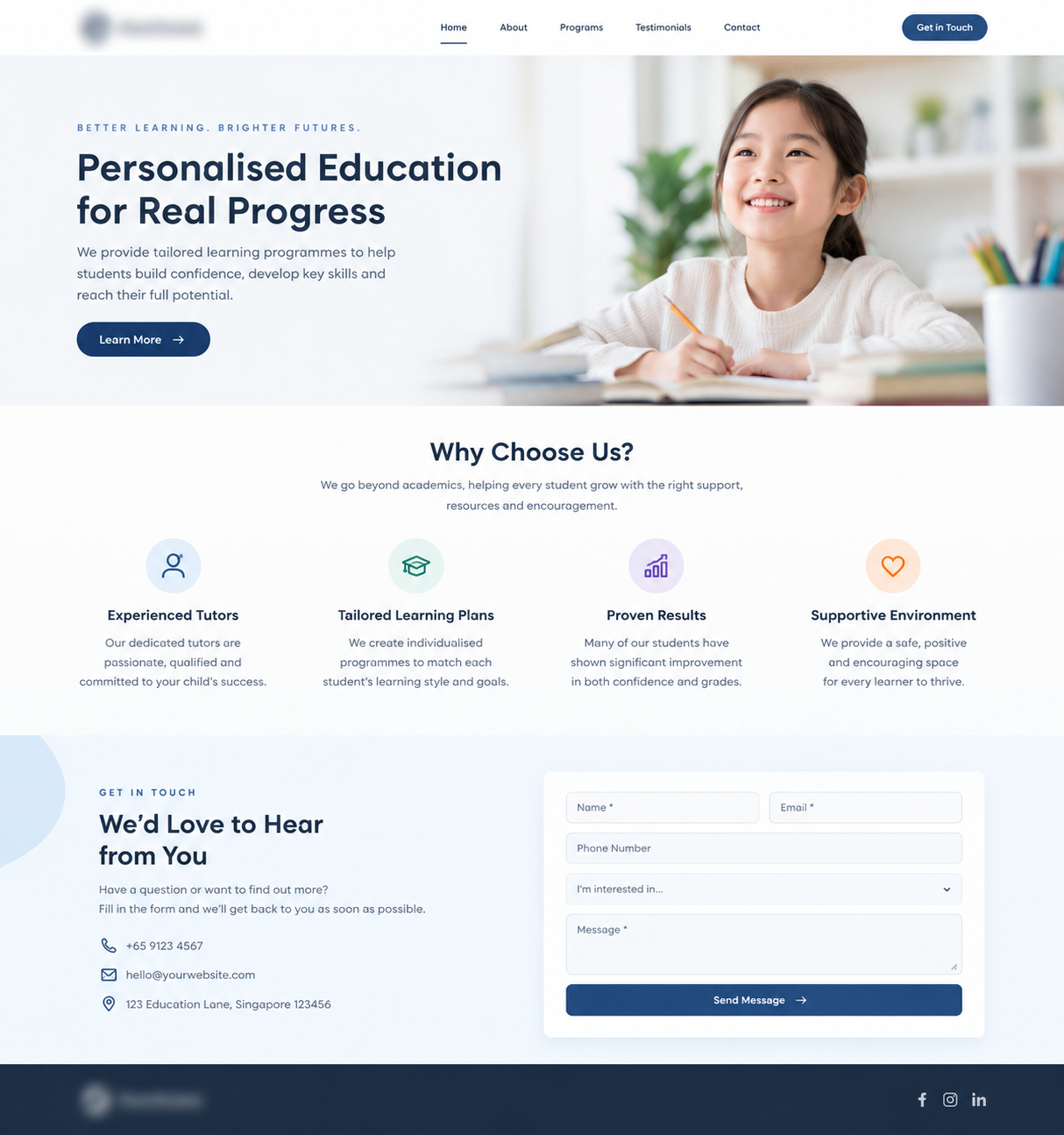
An education client came to us after launching a website built with an AI builder. The site looked finished, but its enquiry form wasn’t actually working, so enquiries from interested parents and students went nowhere. Fixing it wasn’t simple either, because the builder made it difficult to set up SMTP properly, the email configuration that makes form submissions reliably reach your inbox. A website that looks complete can still be quietly losing you customers.
An AI builder looks cheaper on day one. The comparison changes once you count what happens when the site stops being enough.
| AI builder route | Web design company route | |
|---|---|---|
| Year one | Subscription + your time writing, editing and fixing | One build fee + maintenance |
| Year two | Subscription continues; site outgrown; rebuild needed | Maintenance and small improvements |
| What you've paid for | A site you're replacing | A site still working for you |
This isn’t really a choice between AI and people. Good web designers now use AI to speed up first drafts, research and testing, which keeps costs and timelines down. People still handle what AI does poorly: understanding your customers, writing copy that sounds like you, planning for search, and checking quality before launch.
We use AI to speed up research, first-draft layouts, content outlines and testing. Work that used to take days now takes hours, and those savings show up in your quote and your timeline.
Your website still needs people who understand your customers, write copy that sounds like your business, plan pages around what people search for, and set up the details that make it work. That includes forms, SMTP email delivery, bookings, payments and PDPA consent.
We submit every form, check every page on mobile, and confirm enquiries actually reach your inbox. That's the step AI-built sites most often skip.
You get a website built faster and at a lower cost than a fully manual build, without the generic look, broken features and platform lock-in of a DIY AI site.
Answer these five questions. If you say yes to two or more, a web design company that uses AI will likely pay off.
- Do you want the website to bring in new customers, not just confirm you exist?
- Do you compete with other businesses for the same Google searches?
- Do you need bookings, payments, a CRM connection or more than one language?
- Will the site still need to serve you in two years?
- Would you rather spend your time running the business than editing a website?
Thinking about building a website with AI?
Discover how a website design company can incorporate AI to create a great website for your business.

FAQ
Not automatically. Google judges content on quality and usefulness, not on whether AI wrote it. AI-built sites tend to struggle because their copy is generic and their page structure isn't planned around what customers search for.
It can help write drafts and code snippets, but it won't plan, build, host and maintain a complete business website for you. You still need a platform and someone to put it together and check it.
Yes. Expect to rebuild rather than upgrade, though, because most AI-built sites can't be moved off their platform.
The platform may provide tools, but setting up consent, privacy notices and data handling correctly for your business is your responsibility.
Much cheaper upfront. Over two to three years the gap narrows, especially if the site needs rebuilding.